 Kosken
Product
From a failed signal to a checked fix
Kosken opens an incident when a signal fails, writes the root cause with evidence, and, if a fix is needed, proposes a signed recipe. Models write text. Code makes every decision that changes a machine.
Free for up to 5 machines. Every machine starts in audit mode: Kosken reads and reports, and changes nothing.
Five steps, from alert to fix
Models write text in three of the steps. Code makes every decision that changes a machine.
A signal fails
An agent on the machine reports a fact, for example disk use above 90 percent. A rule opens the incident. code
Triage
A model reads the signal and proposes a severity and a class. A safety classifier checks the output. model, then code
Diagnosis
A model reads evidence from the machine and writes the root cause analysis. It can end with
conclude, which takes no action. It has no tool to close an incident. modelReport
The report cites evidence IDs. A check flags each claim that has no evidence. model, then code
Execution
The model selects a recipe from a closed, signed catalog. Five gates in code decide whether it runs, waits for a person, or stops. A separate process on the machine runs it and checks the result. code
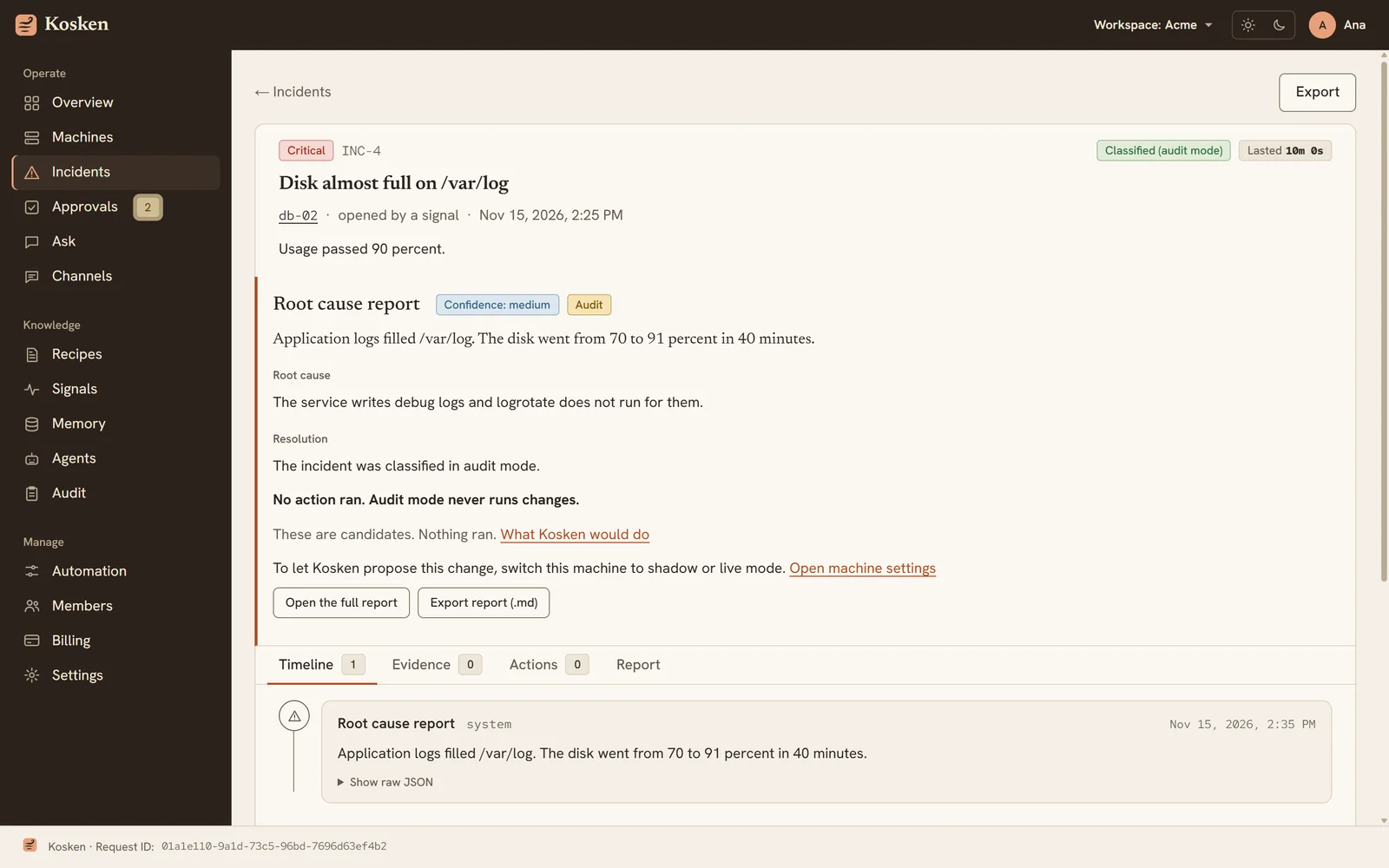
One page for each incident
The incident page holds the signals, the triage, the diagnosis, the report, the proposal, the decision of the person, the run and the check of the fix, with the time of each stage.
After the fix
- The fix is checked
After a recipe runs, its verify step checks the machine, and Kosken checks that the signals cleared. Only then is the incident resolved.
- A failed check rolls back once
When the verify step fails, or the signal stays, Kosken runs the rollback of the recipe one time, if the recipe has one. Then a person must act.
- A refused action does not wait in silence
When the gates refuse the action of a diagnosis, the incident goes to a person at once, with the recipe and the reason.
- Memory of past incidents
Kosken keeps the past incidents and the fixes that worked. The diagnosis can read them for the same machine.
More of Kosken
- MonitoringMonitors for services, ports, URLs, containers, disks and logs.
- Recipes and approvalsSigned fixes, five gates in code, and a person who decides.
- Tasks and maintenanceScheduled checks, planned changes, and the jobs of each machine.
- Fleet and modesMachines, workloads, and the audit, shadow and live modes.
- Ask KoskenAsk about your fleet in plain words, with your own models.