 Kosken
Product
Signed fixes, and a person who decides
Recipes are the runbook automation of Kosken. A model can select a recipe and fill its parameters. It cannot write a new step. Five gates in code decide what happens next.
Free for up to 5 machines. Every machine starts in audit mode: Kosken reads and reports, and changes nothing.
A closed catalog of recipes
- Signed and typed
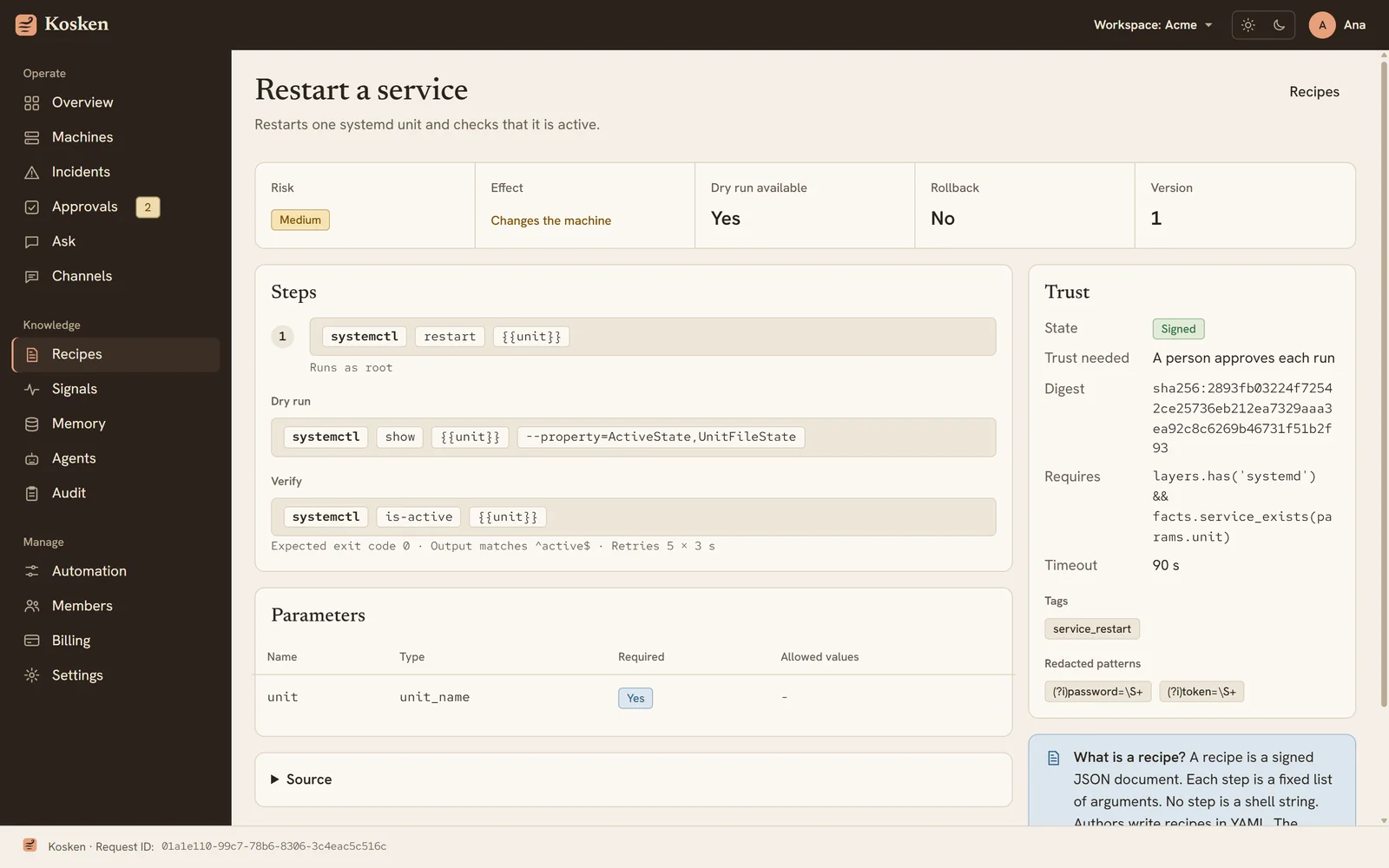
A recipe is a signed document. Each step is a fixed list of arguments with typed parameters. No step is a shell string.
- Read it before it runs
Each recipe page shows the steps, the dry run, the check that proves the fix worked, the digest, and the signature state. Anyone who can approve a run can read the same text first.
- An executor that cannot reach the network
A separate root process on the machine runs the recipe. The unit sets
PrivateNetwork=yesandRestrictAddressFamilies=AF_UNIX. It verifies the signature with keys built into the binary.
Five gates, all in code
When a gate asks for approval, the request goes to the Approvals page. It shows the recipe, the parameters, the risk, the reasons, and the answers of the Guardian and the safety classifier.
- The gates
Gate 1 reads the machine mode. Gate 4 checks the recipe, its parameters and the state of the machine. Gate 2 reads the trust of the recipe on that machine. Gate 5 is a safety classifier that never sees the diagnosis. Gate 3 combines the answers.
- When a person decides
A risk above low, a recipe with no trust on that machine, or a gate that cannot decide sends the request to a person. In live mode, a low-risk recipe that earned trust on that machine can run without one.
- High risk needs two people
A high-risk request needs a second person with write access. When the workspace has one writer, that person confirms their identity again before they approve.
- Old data asks, it does not refuse
When only the stored facts of a machine fail, Kosken asks a person and says why. The executor checks the same precondition again on the machine, with live facts, before it runs.
Ask for one recipe yourself
A person with write access can ask for one exact recipe on one machine, for example to pause a timer or change a cron line. The request goes through the same gates. A low or medium risk runs when the person asks. A high risk needs another writer. Kosken refuses a critical recipe.
More of Kosken
- Incident responseFrom a failed signal to a root cause report and a checked fix.
- MonitoringMonitors for services, ports, URLs, containers, disks and logs.
- Tasks and maintenanceScheduled checks, planned changes, and the jobs of each machine.
- Fleet and modesMachines, workloads, and the audit, shadow and live modes.
- Ask KoskenAsk about your fleet in plain words, with your own models.